

Hidden Indonesia: Flores, Papua, and Borneo
Surely, you haven't even thought that Indonesia consists of more than 17,000 islands. Within just a few hours' flight from Bali, there are places where ancient human remains have been found in caves, where mountain villages still ask ancestors for permission to accept guests, and where orangutans in jungles are called “people of the forest.”
In this article, we've gathered three of the most unusual trips - to Flores, Papua, and Borneo. These are destinations not just to check off a list or to quickly see in a day. People come here to see pristine Indonesia - unexpected and much deeper than one can imagine.

On Flores, local legends about little people surprisingly echo a real archaeological finding. In Papua, the life of highland villages developed for centuries with hardly any contact with the outside world. And on Borneo, you can see orangutans in their natural habitat within dense tropical jungles.
We'll tell you what to expect from each destination, how our tours are organized, and what is important to consider before the trip. What secrets does the island of Flores hold, how to prepare for traveling to Papua and exploring Borneo's jungles? Discover the legends and mysteries of tropical islands with MyBaliTrips.
Journey to Flores Island
Flores is best known for Komodo National Park. Travelers usually fly into Labuan Bajo to see Komodo dragons, climb to Padar's lookout, spend a day on a boat between islands, and relax on pink beaches. However, they often miss the island itself - with mountain villages, rice fields, waterfalls, and Liang Bua cave.
Labuan Bajo is a convenient starting point for the entire trip. It's easily accessible from the airport by transfer. Here, you can book boats, yachts, and sea tours around the islands for diving and snorkeling, with hotels and resorts for any type of rest, to stay before or after visiting Komodo.

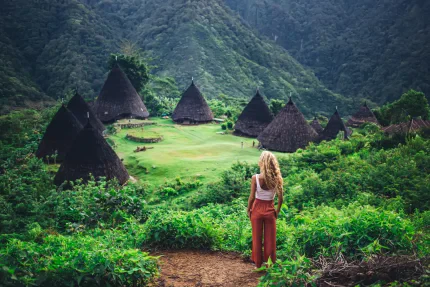
There's no need to leave immediately; Flores itself deserves just as much attention and offers a truly authentic experience. Wae-Rebo is a mountain village with traditional cone-shaped mbaru niang houses. Visitors stay overnight: local residents host guests in a communal house, prepare dinner, and introduce them to the rules of Wae-Rebo life. Before accepting new people, the village elder turns to the ancestors of the village and asks for permission to welcome guests.
In the central part of the island lies Liang Bua cave. It was here in 2003 that the remains of Homo floresiensis - an ancient small-statured human, later nicknamed the “Flores Hobbit” - were found. For a long time, stories about small forest creatures Ebu Gogo have been told on the island. Scientists don't consider these tales as evidence of a connection to the discovery, but the similarity between the legend and the real discovery still raises many questions.

In a three-day journey across Flores overnight stays in Wae-Rebo and Ruteng are already arranged, along with a car with a driver, meals, entrance tickets, and all transportation between locations. There's no need to separately search for hotels along the route, arrange transfers from Labuan Bajo, or assemble a trip to the mountain areas of the island piece by piece. This route conveniently combines with a trip to Komodo National Park, allowing you to discover not just the archipelago islands but Flores itself.
Cultural Journey to Papua Highlands
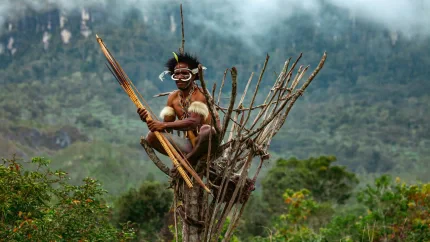
If you think you've already seen unusual Indonesia, then you clearly haven't been to Papua. This is one of the most remote and unique regions of the country. The highland part of Papua remained mostly unknown to the outside world for a long time. It was only in 1938 that explorers discovered that tens of thousands of people were living among these mountains, having developed their own culture in complete isolation from the rest of the world for centuries.
This culture still lives in the Baliem Valley. Located between mountain slopes are villages of the Dani people, sweet potato fields, suspension bridges, and trails used by locals to travel between settlements. During the journey, you can trek through the southern part of the valley, see traditional houses, agricultural terraces, and the everyday life of the region, which has largely preserved the local way of life. Here, they even still keep smoked mummies of chiefs. The most famous of them are estimated to be 250 to 370 years old. For locals, these are not exhibits but memories of people considered important to the community during their lives. Don't be afraid; guests are introduced to them only with the permission of the family or village.

One of the most memorable moments of the trip will be attending a traditional pig feast ceremony. Residents of several villages gather: they cook pork, sweet potatoes, and vegetables in an earth oven with heated stones, cover the food with leaves, and leave it to cook underground. For the Dani people, this is an important communal event, associated with hospitality, family gatherings, and community life.
Papua requires a bit more careful preparation than trips to Bali or Komodo. For entering Indonesian Papua, there are usually no mandatory vaccinations. An exception is the yellow fever vaccination certificate if you are arriving from a country where the disease is widespread. For the trip to Baliem Valley itself, it’s worth checking your basic vaccinations, and discussing Hepatitis A, Typhoid vaccinations, and malaria prevention with your doctor: Papua is one of the regions in Indonesia where the risk of malaria persists. You'll need insect repellent, lightweight protective clothing, a personal first aid kit and insurance covering medical evacuation for the journey.

Our tour starts in Wamena - the main city of the Baliem Valley, which can be reached via domestic flights. Foreign citizens need a special permit called Surat Jalan to visit Papua: it is arranged in advance with passport details and a photo. The four-day expedition already includes three nights in the valley, a local guide, airport transfers, meals, excursions, entrance tickets, and permit arrangements. Papua is precisely the kind of destination where a single trip can change your perception of the entire country.
Tour to Borneo Orangutans
Borneo is one of the wildest and least explored destinations in all of Indonesia. Far fewer travelers come here compared to the country's popular islands, and most of the territory is still covered by ancient jungles over 130 million years old — some of the oldest tropical forests on the planet.
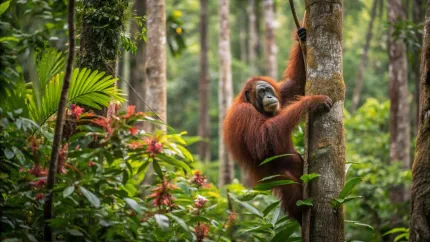
It is in these forests that orangutans live. Their name translates from Indonesian as “man of the forest”: they spend most of their lives in the treetops, where they make nests and raise their young. In Tanjung Puting National Park, orangutans can be seen in their natural environment - on forest trails and special feeding platforms that operate as part of animal rehabilitation programs. Here you can also find proboscis monkeys, gibbons, macaques, crocodiles, and many birds. Proboscis monkeys are often spotted near the riverbanks come evening. Incidentally, these monkeys live only on Borneo.

The journey to the national park begins in Pangkalan Bun. From the airport, travelers are taken to the port of Kumai, where the river journey begins on a boat. Over the next two days, the boat becomes both transport and home: meals are prepared onboard, and people sleep in cabins or on the open deck, surrounded by continuous jungle views. Within the first hours, you can spot birds and wildlife along the banks. For forest walks and evenings on the river, it's best to bring insect repellent and lightweight closed clothing: there are many mosquitoes in the national park, especially post-sunset.
The tour to Borneo also includes visits to the Pondok Tanggui center and Camp Leakey - a research station that has been working with orangutans since 1971. Here, you can see animals during feeding and learn about their rehabilitation before returning to the forest. It's important to follow park rules: don't approach orangutans without permission from a guide, don't touch or feed them independently. Orangutans are susceptible to human viruses, so if you show signs of a cold, it's best to postpone the trip.
No special preparation is required for a trip to Borneo: there's no need to arrange a special permit or prior arrangement with villages, as in Papua. The three-day trip already includes transfers from Pangkalan Bun airport, accommodation on the boat, meals, an English-speaking guide, entrance fees, and a donation to the national park. Flights to Borneo are paid separately, as well as insurance and personal expenses.Traveling to Borneo offers a rare experience and a way to view a world where humans remain merely guests of nature.
Frequently Asked Questions
Do you need special permits for these trips?
Only for Papua. Foreigners are issued a Surat Jalan pass to visit the Baliem Valley - based on passport data and a photo, in advance. In our tour, the paperwork is included. For Flores and Borneo, a regular Indonesian visa is sufficient.
How to get there from Bali?
Flores is accessed from Denpasar to Labuan Bajo - the main airport for trips to Komodo and the island itself. For Papua, the route usually passes through Jayapura on the northern coast of the New Guinea island or another major Indonesian city, followed by a domestic flight to Wamena. For Borneo, fly into Pangkalan Bun, from where the transfer to Kumai port and further river journey begins. Direct flights are not always available, so such trips are better planned in advance, allowing time for layovers.
Are vaccinations needed?
No mandatory vaccinations are needed for entering Flores, Borneo, or Indonesian Papua. The exception is a yellow fever certificate if arriving from a country where the risk of its spread exists. For Papua, checking standard vaccinations in advance and discussing Hepatitis A, Typhoid vaccination, and malaria prevention with a doctor is advisable. For all three destinations, insect repellent, a personal first aid kit, and insurance covering treatment and emergency assistance will be useful.

How physically demanding are the routes?
Flores is suitable for most travelers in normal physical condition: the main demands are related to moving around, climbing to the village of Wae-Rebo, and walks through nature spots. Papua requires more endurance: there are treks, mountain trails, and moves between villages in Baliem Valley. Borneo is physically easier: most of the journey is spent on a boat, but there are forest walks, humidity, heat, and insects. Comfortable footwear, lightweight protective clothing, and readiness for simple conditions outside usual tourist zones are recommended for all destinations.
When is the best time to go?
Flores, Papua, and Borneo are accessible year-round, but it’s more comfortable to plan a trip during the dry season – roughly from April to October. During this time, traveling, trekking, and jungle walking are usually easier. However, on Borneo and in Papua, the weather can change rapidly even in a good season: tropical rain is common here, so it's best to take a lightweight raincoat regardless.

Try the best Indonesian dishes in Bali, which will introduce you to unique flavors and the rich culture of local cuisine.

Futuristic landscapes, pink beaches and an underwater world full of colors attract travelers from all over the world.

What to do if Bali has already been explored: comparing islands in Indonesia - routes, tours, boats.

Choosing snorkeling spots in Bali and neighboring islands

